
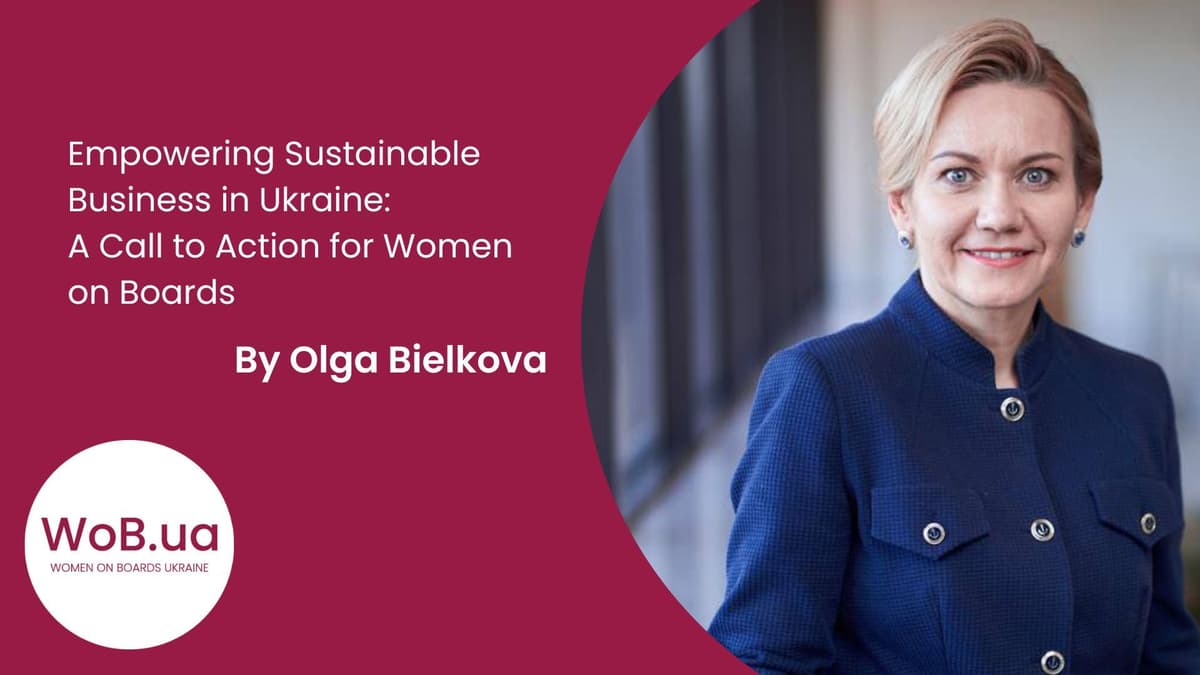
Empowering Sustainable Business in Ukraine: A Call to Action for Women on Board by Olga Bielkova
2023-11-17
Empowering Sustainable Business in Ukraine
The turbulence of recent years with COVID, the war in Ukraine, and the recent development of the conflict in Gaza have brought security and business sustainability into corporate agendas as new practical components. I advocate for a paradigm shift, urging our community to champion "“sustainability for security"” as a pivotal focus in Ukrainian boardrooms to prepare each company for a sustainable future in the interests of Ukraine.
The sustainability discussion has evolved from a distant concept introduced by academia and NGOs to a fundamental business survival strategy. Drawing inspiration from influential sources, such as "“The Board’s Role in Sustainability"” by Eccles et al. (Harvard Business Review) and "“Board Oversight of Sustainability and ESG"” by the International Federation of Accountants, we are presented with frameworks that advocate for director engagement in Environmental, Social, and Governance (ESG) efforts.
In learning sustainable practices, we must consider How Boards Can Focus on What Matters in Sustainability," as the Boston Consulting Group outlines. The emphasis here is on governance improvement by prioritizing key aspects that truly matter in the sustainability discourse. McKinsey & Company'’s insights in "“Organizing for Sustainability Success"” guide us in setting targets, developing initiatives, and embedding sustainability into day-to-day operations. But companies in Ukraine must be even more thoughtful and define their sustainability in a broader way.
Right now, businesses in Ukraine are starting to navigate the complexities of longer-term military operations. Ukraine will win, but the timeline uncertainty requires each enterprise to have plans A, B, and C with strategic responses. Planning for the next 3, 5, or 10 years, along with military insecurities, becomes not an intellectual exercise but a pragmatic answer to different scenarios of external events. These plans are a must, ranging from overall strategy change to the potential partial impact on new product launches and construction of production sites and staff policies.
Ensuring energy security has become a critical concern for those dependent on a stable and affordable energy supply. Pretty much everyone. The prospect of interrupted electricity should prompt businesses to address this challenge proactively. Developing energy-saving plans and exploring options for self-sufficiency in energy generation are a new normal for households and companies. Additionally, having a contingency plan to navigate potential disruptions in the energy market within Ukraine and the broader region becomes paramount for sustainable operations.
As Ukraine approaches the EU, businesses must align with evolving Environmental, Social, and Governance (ESG) requirements. The accelerated entrance into the EU market necessitates a thorough assessment of readiness and a strategic approach to compete effectively with peers.
Furthermore, aligning with Europe'’s ambitious climate and environmental standards, as outlined in the EU'’s Green Deal and taxonomies, presents a multifaceted challenge for businesses. The impact on production and consumption practices requires careful evaluation. Companies must proactively strategize to ensure alignment with these evolving environmental standards, recognizing the imperative of sustainability in a global context.
Make no mistake, Ukrainian businesses have challenges and opportunities. While we fight the war in Ukraine, the rest of the world is looking into climate change, decarbonization, and measuring ESG metrics. To ensure survival beyond the war and sustainable growth in a rapidly evolving landscape around us we cannot postpone our preparation until the war'’s end; somebody should urge proactive and strategic research and discussion now.
Members of Women on Board are uniquely positioned to start these discussions within their organizations and beyond. Many of us are currently exposed to business communities and networks in Europe. Why not study European experience in sustainability and cases of companies' and industries' transformations? It could be a significant contribution to preparing Ukrainian companies and the whole country for the inevitable change.
Our role extends to specifically preparing companies for potential EU integration. Are we ready to compete with EU producers on their turf, adhering to their environmental and social standards? This is where the distinct perspective of Women on Board becomes invaluable. Just as essential as audit or remuneration committees, I propose the establishment of a dedicated "Long-term Sustainability Committee" for each company with a specific meaning for Ukraine. This committee should oversee and drive sustainability initiatives within the company for the next 10-20 years.
In conclusion, I invite my fellow WoB Ukraine members to see a board mission in adapting to wartime survival and to lead the charge in shaping a sustainable future for Ukrainian businesses now and in the EU. We can ensure that our business is aligned with EU sustainability standards by leveraging the necessity and unavoidability of change because of the war. This is how our business will have to survive upon our Victory.